
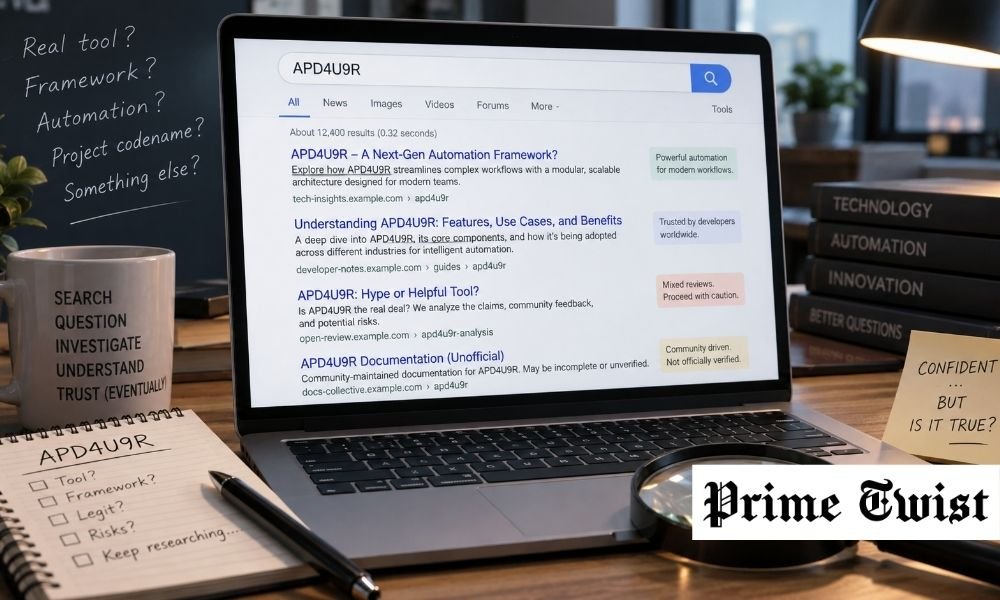
A reader sees the term APD4U9R online. It looks serious. It has letters and numbers. It feels like a code, a tool name, or a new tech system. So the reader opens Google and searches it.
At first, the results look helpful. Some headlines sound very sure. Some pages call APD4U9R a digital framework. Some connect it with automation, data, security, and modern business tools. One result even treats it like a tool for digital transformation, but also says it may be a placeholder name that should be replaced with the real tool name. That small warning changes the whole story.
Now the reader has a question. Is APD4U9R a real framework? Is it a code? Is it only a keyword that many websites copied? This article is not here to pretend we have all the answers. It is here to show why online confidence is not always proof.
Why APD4U9R Looks Real at First
APD4U9R looks like something from a tech manual. It is short. It is mixed with letters and numbers. It does not look like a normal word. That makes it feel official.
Many people trust this kind of term too fast. A word like APD4U9R may sound like a system ID, software version, product code, or hidden framework. Readers may think, “This must mean something technical.”
That feeling is easy to understand. In the tech world, many real names look strange. Software builds, product codes, database IDs, and security tokens can all look random. So when a reader sees APD4U9R, they may believe it has a fixed meaning.
But a serious-looking term is not the same as a verified term.
The Search Results Sound Too Sure
The first problem is confidence. Some articles describe APD4U9R as if its meaning is already settled. They use words like framework, automation, data processing, security, and business performance. One page says APD4U9R is a digital technology framework made to improve business work through automation, data management, and security.
Another page describes APD4U9R as a workflow platform for modern businesses. It connects the term with real-time analytics, AI-powered insights, and business operations.
These claims may sound strong. But a careful reader should ask a simple question: where is the official source?
If APD4U9R is a real product, where is the company page? If it is a real framework, where is the documentation? If it is a real standard, where is the standards body? Search results can repeat a claim, but they do not always prove it.
Repeated Claims Do Not Always Mean Truth
One of the biggest traps online is repetition. A reader may see the same idea on many websites and think it must be true. But repeated words can come from copied ideas, rewritten posts, or low-quality SEO content.
This matters because APD4U9R does not have one clear public meaning across results. Some pages frame it as a business framework. Some frame it as a workflow tool. Another source says APD4U9R could be a unique identifier used in systems, software, data, or cybersecurity contexts.
That mixed picture is important. It does not prove APD4U9R is fake. It also does not prove it is real. It only shows that readers should slow down.
A strong article does not say, “Everyone says it, so it is true.” A strong article says, “Here is what is claimed, here is what is proven, and here is what is still unclear.”
The Placeholder Warning
The most interesting clue is the placeholder warning. One page about APD4U9R says it is “assuming this is a placeholder for a specific tool” and says the real tool name should be used for accuracy.
That line is very important. It means the writer may not have been talking about a known tool at all. The term may have been used as a sample name. It may have been inserted into a general article about digital transformation. It may not be a verified brand or framework.
This is where the reader’s trust starts to break. If one article says APD4U9R is a tool, another says it is a framework, and another says it may be a placeholder, then the safe answer is not to guess.
The safe answer is: APD4U9R needs more proof before anyone calls it a confirmed technology.
Why Tech Words Can Hide Weak Proof
Tech writing often uses big words. Some of these words are useful. Others can hide weak information.
Words like automation, intelligence, data, security, cloud, analytics, and digital transformation sound powerful. They make a topic feel modern. But when these words appear without proof, they can mislead readers.
For example, saying APD4U9R improves business operations sounds helpful. But readers need details. Who built it? What problem does it solve? Where can people test it? Does it have a website? Does it have customers? Does it have clear documentation?
Without these details, the words are only claims.
This is the main trust problem. The article may sound smart, but the proof may be thin.
The Reader Starts Checking Better Sources
A careful reader does not stop at blog posts. They begin to check stronger sources.
They may search for an official APD4U9R website. They may look for product documentation. They may check GitHub. They may search patent or trademark databases. They may look for a company profile, app listing, press release, developer page, or user guide.
This step is simple, but it matters. Good research starts with primary sources. A primary source is the original place where information comes from. A company website, official manual, patent record, or developer document is stronger than a copied blog post.
For APD4U9R, the public results are mixed. That does not mean every article is wrong. It means readers should not treat broad claims as final truth.
What Strong Proof Looks Like
Strong proof is not hard to understand. It usually has clear signs.
A real product should have a clear owner. It should have a website, support page, pricing page, help guide, or contact details. A real software tool may have a release history, developer docs, screenshots, user reviews, or public changelog.
A real framework may have technical documentation. It may explain how it works. It may list use cases. It may show examples. It may name the people, company, or group behind it.
A real standard may come from a known standards group. It may have version numbers, dates, and formal documents.
If APD4U9R has these things, writers should link to them. If those things are missing, writers should be honest.
What Weak Proof Looks Like
Weak proof also has signs.
A page may make big claims but give no sources. It may use broad examples but name no real companies. It may say the tool is “changing industries” but show no case study. It may say users love it but give no review source. It may repeat the same points found on other pages.
This kind of content can still rank in search. It can still look neat. It can still use headings, FAQs, and confident wording. But structure is not proof.
This is why APD4U9R is a useful case study. It shows how a strange term can become a search topic even when the public meaning is still unclear.
Why Writers Should Say “Unclear”
Many writers fear the word “unclear.” They think it makes an article look weak. But honest writing is stronger than fake confidence.
If proof is weak, say it is weak. If the term has mixed meanings, say the meanings are mixed. If there is no official source, say no clear official source was found.
For APD4U9R, the better article is not one that invents certainty. The better article is one that explains the problem. It should say that some websites describe APD4U9R as a digital framework, while other results treat it more like a code, identifier, or placeholder-style term.
That is fair. It gives readers the truth without turning guesses into facts.
Is APD4U9R a Framework, a Code, or an SEO-Made Topic?
This is the big question. The honest answer is that APD4U9R is not easy to verify as one official thing from public search results.
It may be a framework. It may be a tool name. It may be a system code. It may be a placeholder. It may also be a keyword that grew because many sites started writing about it.
The important point is not to choose the most exciting answer. The important point is to choose the answer that proof can support.
If an article claims APD4U9R is a proven business platform, it should show proof. If it says APD4U9R is used in cybersecurity, it should show technical support. If it says APD4U9R is used by companies, it should name those companies and explain the source.
Without that, the article should stay careful.
What Readers Can Learn From APD4U9R
APD4U9R teaches a bigger lesson about the internet. Search results can look confident even when the facts are not settled.
This lesson can help readers in many areas. It can help them check tech tools before buying. It can help them avoid weak business advice. It can help them read cybersecurity claims with more care. It can help them understand that a polished article is not always a trusted article.
The surprising benefit of APD4U9R is that it teaches digital doubt. That does not mean readers should reject every new term. It means they should ask better questions.
Who created it? Where is the source? What proof is shown? Are different websites saying the same thing because it is verified, or because they copied one another?
These questions protect readers.
How Writers Can Cover APD4U9R the Right Way
Writers can still write about APD4U9R. But they should do it carefully.
They should avoid saying it is a confirmed product unless they find proof. They should avoid using fake use cases. They should not add made-up company names, fake dates, or false customer stories.
A good writer can build the article around the search confusion. That is more honest and more useful. The article can explain how uncertain tech terms spread. It can show readers how to check sources. It can compare strong proof with weak proof.
That kind of article helps people. It does not just chase a keyword.
Final Thoughts
The story of APD4U9R starts with a simple search. A reader sees a strange term and wants a clear answer. But the search results do not give one clear meaning. Instead, they show a mix of confident claims, broad tech language, and weak proof.
That does not mean APD4U9R is useless. It means the public information needs care. Writers should not turn uncertainty into fact. Readers should not trust confidence without evidence.
APD4U9R may be a real framework, a code, a placeholder, or an SEO-made topic. The most honest answer is that more verification is needed.
In the end, APD4U9R teaches one clear lesson: search results can sound sure, but proof matters more than confidence.