
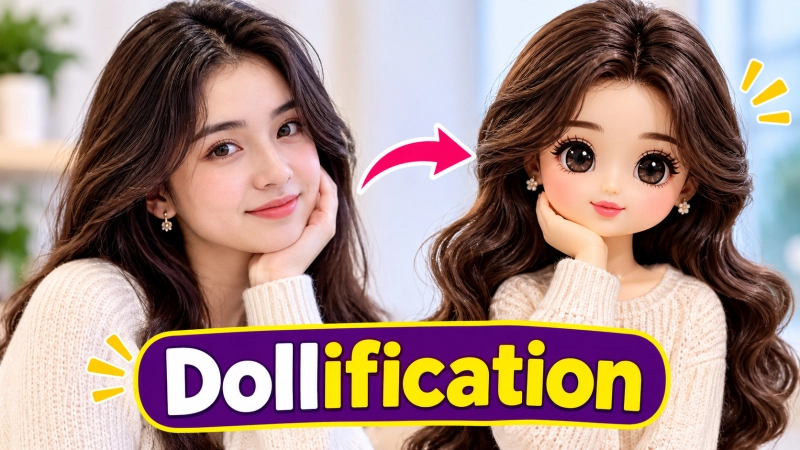
Dollification is a kink in which consenting adults take on the look and behavior of a living doll, or dress and direct a partner as one, usually as part of a power-exchange dynamic. Outside kink circles, people sometimes use the word loosely for doll-inspired beauty trends, but those are a different thing.
That mix-up is the main reason people search the term. Someone sees it in a comment section, under a TikTok makeup video, or in a dating profile, and wants to know what they’re looking at.
This guide explains it plainly, without the sensationalism or the explicit detail.
What Is Dollification?
At its core, it’s role-play. One person becomes “the doll”: dressed up, styled, and posed, often speaking little or acting passive. The other person is usually the one doing the dressing, styling, and directing.
The Homosaurus, an LGBTQ+ vocabulary, in an entry contributed by the Leather Archives & Museum in Chicago, defines it as dressing and acting like a living doll for aesthetic or sexual gratification. That “or” matters. For some people it’s sexual. For others it’s mostly about the look and the feeling of transformation.
It can be solo, too. Some people enjoy styling themselves as a doll for photos with no partner involved at all.
Where Does the Term Come From?
It’s built from “doll” plus “-ification,” the same suffix as in “gamification.” English has used “doll” for living people for centuries; by the late 1700s it could mean a pretty but supposedly silly woman. “Doll up,” meaning to dress up, dates to around 1906 in American English.
The kink-specific usage spread through online fetish communities and got mainstream attention in the mid-2010s. A 2015 Psychology Today blog post and Vice coverage around the same time brought the term to a wider audience.
You’ll also see related terms:
- Rubber dolling: a version built around latex suits and masks
- Doll play: a broader, looser label for the same idea
- Kigurumi or “dolling”: wearing a full-face doll mask, sometimes in a purely costume or cosplay context
How Is Dollification Different From Dollcore and Doll Makeup?
This is where most online explainers go wrong. They lump everything doll-themed together. Here’s how the main uses actually differ:
| Term | What it is | Sexual? | Where you’ll see it |
|---|---|---|---|
| Kink doll play | Adults role-playing as or styling a living doll, often with a power dynamic | Often, not always | Fetish communities, BDSM events, adult forums |
| Dollcore | A fashion and photo aesthetic of dainty outfits and porcelain makeup | No | TikTok, Instagram, Pinterest |
| Doll makeup | Makeup inspired by dolls like Bratz or Blythe: big lashes, heavy blush, glossy lips | No | Beauty tutorials, runways |
| “Bratz doll” or Barbie surgery | Cosmetic procedures chasing a doll-like face or body | No | Plastic surgery consultations, news coverage |
The dollcore numbers show how big the aesthetic side has gotten. Highsnobiety reported in August 2024 that TikTok had over 29 million posts under the hashtag #RulesofDollcore.
So if a friend says they’re “into dolling” because they love blush and lash clusters, they almost certainly mean the aesthetic. Context does all the work here.
What Does It Involve in Practice?
Guides from sex-education sources generally describe three building blocks:
- Appearance. Wigs, makeup, costumes, and sometimes latex, corsets, or doll masks. The goal is a polished, artificial look.
- Behavior. The “doll” may hold still, stay quiet, keep a fixed expression, or follow simple instructions.
- Power dynamic. One partner leads and the other follows. This can be gentle and caretaking or more intense, depending on what both people agreed to.
None of these are required. One couple might only do a dress-up photo session. Another might build a whole evening around it. Two people using the same word can mean very different things, which is exactly why talking first matters.
Why Are People Drawn to It?
The reasons people give tend to cluster around a few themes:
- Letting go of decisions. For a person in a demanding job, spending an evening where someone else makes every choice can feel like a break.
- Transformation. Becoming visibly someone else, with a full costume and makeup, has the same appeal as theater or cosplay.
- Aesthetics. Some people simply love the look: the porcelain finish, the vintage clothes, the careful styling.
- Trust. Handing that much control to a partner requires a lot of it, and some couples say the trust is the point.
Here’s what most explainers miss. For a lot of participants, the appeal is rest, not spectacle. It’s closer to a meditative ritual than the shock-value version you’ll see in headlines.
What Do Critics Say?
Criticism exists, and it’s worth taking seriously rather than brushing aside.
- Feminist critics argue that the doll ideal, passive, silent, and decorative, echoes old stereotypes about women. An essay in the Australian journal Arena connects kink doll play to a wider cultural pattern of objectifying women.
- Beauty critics make a related point about the aesthetic trends. Highsnobiety’s dollcore piece argued the look rewards being expressionless and submissive and noted that Barbie-inspired cosmetic surgery rose after the 2023 Barbie movie.
- Academic work has looked at “dollified” beauty ideals in specific cultures, including a peer-reviewed article on doll-like femininity in South Korea.
Defenders reply that adults choosing a role in private, with consent, is different from society imposing it on everyone. Both points can be true at once. A consensual scene between two partners isn’t the same as a beauty standard sold to teenagers.
What Safety and Consent Basics Apply?
The same ground rules as any kink apply, plus a few specific to costumes and masks:
- Adults only, always. This is an activity for consenting adults. Full stop.
- Talk first. Agree on what’s included, what’s off-limits, and how long the scene lasts.
- Use a safeword or signal. If the “doll” is meant to stay silent, agree on a non-verbal signal, like tapping twice or dropping a held object.
- Watch breathing and heat. Full-face masks and full latex suits can restrict airflow and trap body heat. Keep sessions short at first and have water nearby.
- Check for latex allergy before using rubber gear. Latex allergy is common enough that it’s worth asking every time.
- Mind the body. Holding a pose for a long time can cause cramps or numbness. Build in breaks.
- Plan aftercare. Shifting back out of a passive role can feel strange. A few minutes of normal conversation, a snack, or a cuddle helps.
If something stops feeling good for either person, stop. A scene isn’t a contract.
FAQ
Is dollification always sexual?
No. In kink communities it often has a sexual or power-exchange element, but some people do it purely for the aesthetic or the feeling of transformation. The Leather Archives & Museum’s definition covers both “aesthetic or sexual” motives.
Is dollcore the same thing?
No. Dollcore is a fashion and makeup aesthetic on TikTok and Instagram built around dainty clothes and porcelain-doll makeup. It isn’t a kink, though critics argue both draw on similar ideals of passive, decorative femininity.
What is rubber dolling?
It’s a version of doll play built around latex. Participants typically wear full latex suits and sometimes doll-faced masks, so heat, breathing, and latex allergies are the main safety concerns.
Can men be “dolls” too?
Yes. People of any gender take either role, and the person styling the doll can be any gender as well. The common image of a woman as the doll is a stereotype, not a rule.
Is it safe?
It can be, with the same rules as any kink: adults only, clear consent, a safeword or non-verbal signal, and breaks. Extra care is needed with masks, tight costumes, and long held poses.
Conclusion
The word sounds stranger than the reality. Most of the time it describes adults playing dress-up with a power dynamic attached, and a lot of what gets lumped in with it online is just makeup.
The most useful takeaway: read the context before you react. A lash tutorial and a kink profile can use the same word and mean two completely different things.