
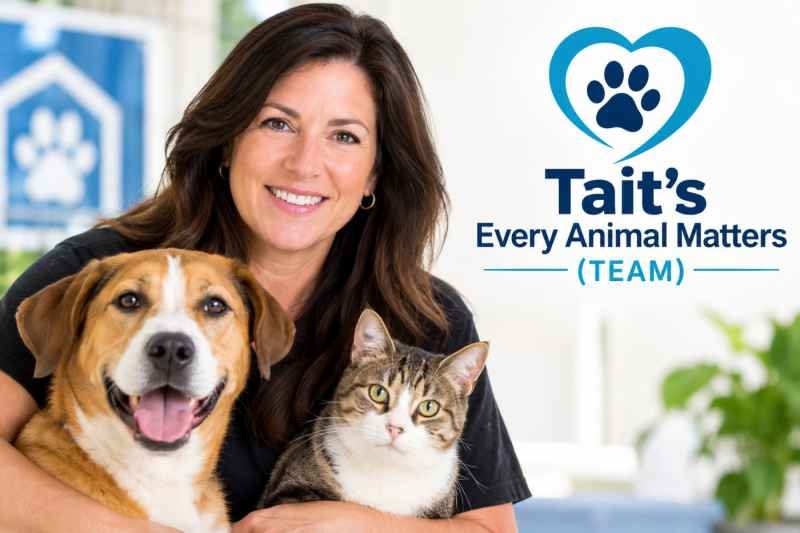
Donna Sicuranza (also known as Donna Sicuranza Marconi) is an American animal welfare executive who serves as the Executive Director of Tait’s Every Animal Matters (TEAM). Since co-founding the organization in 1997, she has guided Connecticut’s first and only statewide mobile feline spay, neuter, and vaccination clinic to sterilize over 225,000 cats. Her work fundamentally changed how the state manages feline overpopulation, shifting the strategy from reactive sheltering to proactive community-level prevention.
Before taking the wheel at Tait’s Every Animal Matters (TEAM), Sicuranza built a career focused on words and public communication. She worked as a freelance writer, editor, and public relations specialist across Connecticut and New York from 1983 until 1997. This deep communication background proved critical when she transitioned full-time into the non-profit sector. Building a grassroots animal welfare program requires more than just clinical skills. It demands the ability to talk to skeptical city officials, write winning grant proposals, and convince communities to trust a medical clinic on wheels.
Sicuranza completed her academic foundations in Connecticut, earning a Bachelor of Arts in English from Fairfield University in 1982. She later earned a Master’s Degree in English Language and Literature from Trinity College-Hartford in 1992. This strong academic grounding in the humanities shaped her methodical, community-first approach to solving large-scale municipal challenges.
The Genesis of TEAM: How It Started in 1997
The story of the mobile clinic began with a shared vision between Donna Sicuranza and the late John Caltabiano, DVM. In the late 1990s, Connecticut shelters were constantly overwhelmed with unwanted litters of kittens. Standard brick-and-mortar veterinary clinics were doing what they could, but many pet owners faced major barriers. High surgery costs, lack of transportation, and a general lack of awareness kept sterilization rates low. Sicuranza and Dr. Caltabiano realized that if cat owners could not get to the clinic, the clinic had to go to the cats.
+--------------------------------------------------------------+

|                    TEAM GROWTH TIMELINE                      |
+--------------------------------------------------------------+

| 1997: Launched with a 22-foot vehicle modifying 12 cats/day. |
| 2019: Crossed the milestone of 200,000 surgeries performed.  |
| 2026: Over 225,000 cats sterilized and vaccinated statewide. |
+--------------------------------------------------------------+
When they launched the program in March 1997, the operation was incredibly modest. They started with a single, cramped 22-foot mobile vehicle. On their very first day of operations, the veterinary crew managed to alter exactly 12 cats. The space inside the vehicle was tight, requiring careful coordination between the surgeon, technicians, and recovery staff.
Skeptics were everywhere during those early months. Many established figures in the veterinary and municipal spaces openly predicted that a mobile surgery unit would fail. Critics argued that the logistics of maintaining sterile fields on a truck would be impossible, or that funding would dry up within a year. Sicuranza often notes that the survival of the program relied entirely on a dedicated network of office staff, maintenance crews, donors, and local caretakers who took a chance on their mobile model.
Inside the Mobile Clinic: How the Operations Work
A modern mobile veterinary clinic is a marvel of spatial efficiency. The current operation utilizes custom-built vehicles specifically designed to optimize every square inch of medical space. A single vehicle can comfortably accommodate the sterilization of 35 cats in a single day’s shift. This massive jump from the original 12-cat limit shows how much the workflows have been refined over decades of real-world practice.
The daily routine requires strict timing. The vehicle arrives early in a designated host community, parking at a pre-arranged site like a library lot, town park, or community center. Caretakers drop off their cats in secure carriers early in the morning. Inside, the medical staff operates with factory-like precision under the guidance of Medical Director Art Heller, DVM, and Senior Veterinary Technician Dina Sicuranza. https://primetwist.co.uk/
Each cat undergoes a pre-surgical physical examination to ensure they are healthy enough for anesthesia. Once cleared, the cat enters the surgical prep area, moves to the sterile operating table, and then proceeds straight to a dedicated recovery zone. Monitors track heart rates and oxygen levels continuously. The team coordinates closely so that as one cat wakes up, the next is prepared, ensuring no time or medical resource is wasted.
The Real Math: Why 225,000 Feline Surgeries Matter
To understand the scope of what Donna Sicuranza has managed, you have to look at exponential growth. A single unspayed female cat, along with her offspring, can theoretically produce thousands of descendants in just a few years. By sterilizing 225,000 cats, the mobile clinic has prevented millions of unwanted births across Connecticut communities.
Consider the sheer physical scale of this work. By the time the organization published its twentieth-anniversary metrics, the team had performed roughly 800 tons of feline surgery. That figure reflects a massive reduction in the burden placed on local animal municipal shelters, control officers, and public budgets.
Feline Sterilization Metrics (1997 - Present)
• Total Cats Sterilized: 225,000+
• Average Daily Capacity per Truck: 35 cats
• Approximate Surgical Mass Handled: 800 tons
• Active Communities Served: 25+ across Connecticut
This volume of operations also provides an exceptional dataset for tracking feline health trends. Every cat that passes through the clinic receives mandatory core vaccinations. This massive influx of vaccinated animals builds a strong barrier of herd immunity against highly contagious diseases like feline panleukopenia and rabies, protecting both domestic pets and local wildlife populations.
What Most People Get Wrong About Feral Cat Management
A common mistake among well-meaning animal lovers is assuming that feral cats can be managed the same way as indoor pets. Feral cats are completely unsocialized to humans. Trapping them, bringing them to a traditional shelter, and hoping for adoption does not work. It leads to high stress for the animal and, unfortunately, very high euthanasia rates in traditional facilities.
Sicuranza and her team champion Trap-Neuter-Return (TNR) as the only effective way to handle community cat populations. Under a proper TNR framework, feral cats are humanely trapped, brought to the mobile unit for surgery, vaccinated, and then returned to their exact outdoor home. The colony size naturally stabilizes over time because the reproductive cycle is stopped.
+-----------------------------------------------------------------+

|                 THE PITFALLS OF THE "VACUUM EFFECT"             |
+-----------------------------------------------------------------+

| What happens when you remove a feral colony entirely?            |
| 1. New, unsterilized cats quickly move into the vacant territory. |
| 2. Food resources remain available, sparking rapid breeding.    |
| 3. The overall feral population rebounds or increases.          |
+-----------------------------------------------------------------+
Simply removing a colony from an area creates a biological void known as the vacuum effect. New, unaltered cats move in to exploit the available food and shelter, restarting the breeding cycle instantly. TNR prevents this by keeping sterilized, healthy cats on-site to defend their territory without producing new litters.
The Economics of Animal Welfare: Package Costs and Subsidies
Affordability is the single biggest factor in achieving high sterilization rates. If a surgery costs several hundred dollars, low-income families and feral colony caretakers simply cannot participate. The model managed by Donna Sicuranza keeps costs low through strategic pricing and targeted subsidy programs.
The standard spay and neuter package is priced at an accessible $110. This comprehensive package covers the essential medical needs that keep an animal healthy and safe:
- Brief Physical Exam: Ensuring the cat is fit for anesthesia.
- The Surgical Procedure: Standard ovariohysterectomy or castration.
- Core Vaccinations: Protection against rabies and distemper.
- Basic Grooming Care: A helpful nail trim.
For community cat advocates, the organization runs the TEAM Incentive Program (TIP). This program provides direct rebates for caretakers managing feral cats that arrive in humane traps. To ensure these cats are easily identified in the field, they receive a small, painless ear-notch while under anesthesia, preventing them from being trapped and brought in for surgery a second time.
Practical Steps for Connecticut Cat Caretakers
If you are a cat owner or community cat caretaker in Connecticut looking to use these mobile services, you need to follow a specific logistical process. The clinic moves constantly, meaning preparation must happen well before the truck arrives in your town.
- Step 1: Check the Mobile Schedule. Review the upcoming calendar to find when a vehicle will park in your region. The fleet regularly visits more than 25 communities across the state.
- Step 2: Secure Your Booking. Contact the administrative staff via email or phone to reserve an exact slot. Drop-ins cannot be accepted due to strict daily surgical limits
- Step 3: Follow Pre-Surgical Fasting Rules. Remove all food from your cat the night before surgery. An empty stomach is absolutely vital for safe anesthesia.
- Step 4: Use Proper Containment. Domestic cats must arrive in clean, plastic hard-sided carriers. Feral cats must remain inside secure, humanely constructed wire traps to keep both the animal and the handlers safe
Frequently Asked Questions About Donna Sicuranza and TEAM
What role does Donna Sicuranza hold at the organization?
Donna Sicuranza is the co-founder and active Executive Director of Tait’s Every Animal Matters (TEAM). She manages the administrative operations, community coordination, and strategic direction of the non-profit.
When was the mobile feline clinic established?
The mobile clinic was officially established in March 1997 by Donna Sicuranza and the late John Caltabiano, DVM. It began as a small, local initiative and grew into a statewide veterinary service.
How many cats has the clinic sterilized to date?
The mobile clinic has successfully sterilized and vaccinated over 225,000 domestic and feral cats across Connecticut since its founding.
What services are included in the standard clinic package?
The baseline $110 package covers a physical examination, the spay or neuter surgery, core rabies and distemper vaccinations, and a nail trim. Additional options like flea treatments and deworming are available for a small fee.
What is the purpose of an ear-notch on a feral cat?
An ear-notch is a small portion removed from the left ear while the cat is asleep during surgery. It serves as a permanent visual marker so rescue workers can quickly identify that the cat has already been sterilized
The Core Takeaway
The most important takeaway from Donna Sicuranza’s long career is that feline overpopulation is entirely preventable when veterinary care becomes mobile and affordable. By removing structural barriers like high costs and difficult transportation, community action naturally follows.