
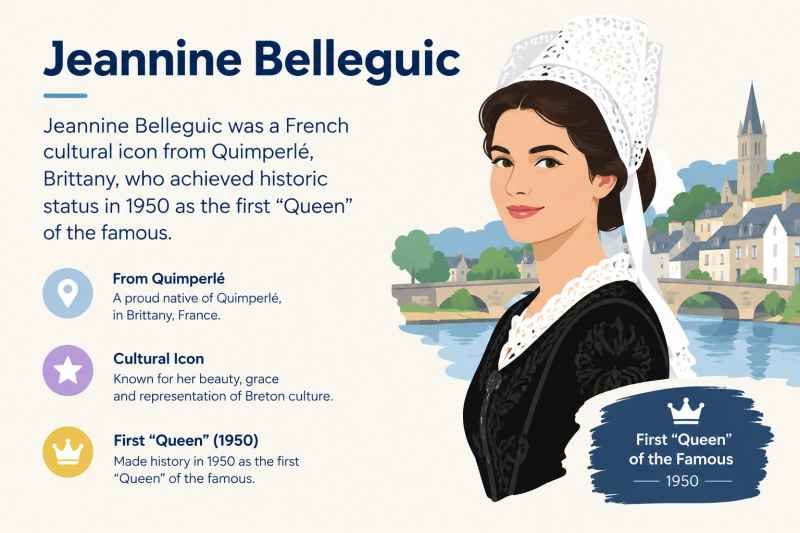
Jeannine Belleguic was a French cultural icon from Quimperlé, Brittany, who achieved historic status in 1950 as the first “Queen” of the famous fêtes de Toulfoën to wear the traditional Breton costume. Her choice transformed a local beauty pageant format into a profound celebration of regional identity.
For decades, cultural events across northwestern France had been shifting away from authentic local roots toward modernized, homogenized formats. When she stepped forward in her local attire, she fundamentally altered how young people viewed their regional roots.
Here is the thing about regional traditions: they die if people treat them like museum pieces. She treated her heritage like a living, breathing identity.
What Was the Significance of the 1950 Toulfoën Festival?
The fêtes de Toulfoën, held annually in the lush national forest bordering Quimperlé, dates back centuries as a massive gathering for music, dance, and community connections. By the mid-20th century, the festival included the election of a festival Queen, a title that usually mirrored mainstream post-war fashion trends.
In 1950, a 19-year-old Jeannine stepped into the spotlight. Born Jeannine Joséphine Annick Bleuzen on May 28, 1931, she chose to bypass modern gowns entirely. https://primetwist.co.uk/
Instead, she appeared before thousands of spectators wearing the intricate lace headdress and heavy embroidery characteristic of the Quimperlé region. It was a bold decision for a young woman at a time when rural traditions were frequently dismissed as outdated.
Consider the sheer scale of the event that year. Historical accounts from the Finistère region show that tens of thousands of attendees crowded into the Toulfoën forest for the festival weekend, making her statement highly visible.
How Did Jeannine Belleguic Champion Breton Heritage?
Most guides to French folklore overlook the subtle political and social weight carried by regional clothing in the mid-1900s. Post-war France was rapidly centralizing, and regional languages like Breton were discouraged in schools.
By wearing the costume during a major public event, she showed that youth could be modern and proud of their ancestry simultaneously. Her appearance catalyzed a revival, encouraging other young women to retrieve their grandmothers’ lace work from family wardrobes.
The traditional attire she wore was highly complex. The outfit featured specific elements unique to her hometown:
- The coiffe, a towering, meticulously starched lace headdress that required hours of preparation.
- A dark velvet or heavy satin dress adorned with distinctive local embroidery patterns.
- An intricately pinned shawl draped precisely across the shoulders to signify regional affiliation.
What Was Her Life Like Beyond the Festival?
Following her historic turn as the festival Queen, she chose a quiet, deeply community-focused life in her beloved Brittany. She married Jean-Charles Belleguic, a native of Quimperlé born in 1924, who sadly passed away in 1979.
In line with local French customs of her generation, she was widely known in community announcements and municipal registers as Madame Jean-Charles Belleguic. She focused her energy on raising her family and passing down the oral histories of her region to her children.
She lived to the remarkable age of 93, watching her family grow across multiple generations. Her family tree eventually grew to include three children—Gilles, Catherine, and Pierre-Yves—alongside six grandchildren and ten great-grandchildren.
She spent her final years in the coastal city of Lorient, where she passed away on April 18, 2025. Her passing marked the end of an era for the local preservation societies that still study the mid-century cultural revival.
Why Does the Legacy of Jeannine Belleguic Matter Today?
When someone passes away at 93, people often focus entirely on the final, quiet years of their life. But the town of Quimperlé did not forget what she accomplished as a teenager.
Her funeral mass on April 25, 2025, at the historic Église Notre-Dame of Quimperlé, drew locals who still respect the statement she made in 1950. She was later laid to rest in the town’s Saint-David Cemetery, returning permanently to the soil of the community she championed.
What most people miss about her story is how a single, simple action can preserve a culture. Today, when you visit Brittany during the summer, you see thousands of young people dancing the fest-noz in full traditional dress. That vibrant modern scene exists because people like Jeannine refused to let their culture fade into the background.
FAQ Section
Who exactly was Jeannine Belleguic?
She was a French cultural figure from Brittany who gained historical recognition as the first Queen of the Toulfoën festival to wear traditional Breton clothing. Her actions in 1950 helped spark a modern appreciation for regional identity and historic textiles.
When and where was she born?
She was born on May 28, 1931, in the town of Quimperlé, located in the Finistère department of Brittany, France. She spent the vast majority of her life deeply connected to this specific geographic area.
Why was her choice of clothing at the 1950 festival historic?
Before 1950, festival Queens typically wore contemporary, mainstream dresses influenced by post-war urban fashion. Her decision to wear a traditional lace coiffe and embroidered dress re-established regional attire as an item of pride for younger generations.
When did Jeannine Belleguic pass away?
She passed away at the age of 93 on April 18, 2025, in Lorient, France. Her life was celebrated shortly after with a community funeral service at the Église Notre-Dame of Quimperlé.
Conclusion
True cultural preservation does not come from books; it comes from people who choose to live their heritage out loud. The single most useful takeaway from the life of Jeannine Belleguic is that honoring your roots in the present is the only way to keep them alive for the future.